Gail Hughbanks Woerner
​
  • Home
  • Way Out West Blog
  • Books
    • Western Women Who Dared To Be Different
    • The Cowboy's Turtle Association
    • Rope to Win
    • Cowboy Up
    • Belly Full of Bedsprings
    • Fearless Funnymen
    • Willard, Colorado: A Special Place in Time
  • Contact
  • About
  • Schedule
  • Rodeo Clown Reunion
  • Links

March 08th, 2017

3/8/2017

0 Comments


Back When the Broncs Were All Tough!!
4th Installment

As I go through all the old periodicals from early days of rodeo I discover such amazing respect and reverence for the broncs that were picked for competition in the early days.  These are some of the articles and comments I have found:
 
Written by Don Bell, of Byron, WY, “In the old days we never had such a thing as “Bucking Horse of the Year.”  They were all tough, all sunsabucks.  I’m sure some of the old boys will remember George Tate of Meeker, Colorado, who had the Spade horses.  Deuce and Diamond were recognized as the best saddle broncs in the business.  When that first air service flew overseas, they called the plane “The China Clipper” and Tate had a tough bronc by the same name.

McCarty and Elliott (and later Nesbitt) had some good horses, although 11:55, as we called little Five Minutes to Midnight, was the rep horse.  Pete Grubb was the first rider I saw make a qualified ride on him. at Cheyenne in about 1935.  But he never fired good.  They also had a roan horse called Squaw Chaser.  He was hell to make a qualified ride on – crooked in the shoulder and a rider never looked good.  But Milt Moe could always win on him.  They also had a big bay called Whizzer White, Ham What Am and Flying Irishman – these, too, were money horses if you could stay on.

I think the sharpest bronc rider ever was Fritz Truan.  He and Ken Roberts were the first riders to look straight up while riding.  It looked good and soon every rider was looking heavenward.  . . . Earl Anderson, a stock contractor from Grover, Colorado, had a good string of horses.  His best, to my way of thinking, was Cole Creek, a sorrel, hard to ride, high kicking, and always throwing his head back and giving you rein.

Johnny Winants of Manderson, Wyoming, had some great broncs all big, 1,600 pound Canadian horses.  West of The Yellowstone and Stone Bruise were his tops.  He had a gray called Walter Winchell, a pay-day bronc if there ever was one.  John Turnicluff of Roscoe, Montana, had a horse called Six Shooter.  Many tried him and many lost.”
 
When Phil Meadows received the first Rodeo Historical Society Award for Sharing Stories, he said, “It is my strong belief that those people and those animals whose very best efforts went into their performances (rodeo) are deserving of some mention in the annals of western history . . . and that if these things are not recorded, their feats and their records will be consigned to oblivion.  Therefore it is my pleasure to write of these things.”
 
In the 1926 Chicago Rodeo, managed and directed by Tex Austin at Soldier’s Field, on August 14th through 22. . . These fellows entered the saddle bronc riding:  Bob Askin, Breezy Cox, Nowata Slim, Bryan Roach, Howard Tegland, Hugh Strickland, Paddy Ryan and Perry Ivory.  The broncs they rode, or tried to ride – Headlight, Rawlin’s Gray, Sundown, Pretty Dick, Flashlight, Satan, Double Trouble, Bear Cat, Rocking Chair, Overall Bill, Cross O Baldy, Deerfoot and Keen Cutter.
 
Headlines:  “Two Reputedly Unridable Broncs Were Both Conquered the Same Year – 1917.”
Coyote and Blue Jay were once considered unridable by some of the best bronc riders in the business.  Yet, in 1917, they were both ridden.  Coyote, the spinning bucking horse of the old Millerick string in California, was ridden at the San Jose Roundup on July 1st by Phil Stadtler, a young cowboy barely out of his teens. One of Phil’s sisters, either Rose or Bertha, rode the famous bronc Square Deal, that same afternoon.  This was reported in the San Francisco Bulletin on page 8, Monday July 2, 1917.  Eddie McCarty later purchased both broncs, and it is said McCarty never could ride Square Deal.  Also 1917 E. J. Scott’s famous horse, Blue Jay, was ridden by Rufus Rollins at the Fort Worth rodeo in March.  (Blue Jay was on the cover of the Wild Bunch back in 1917).
 
            “Hippy Burmister Recalls Confrontation With Steamboat at Alliance, Nebraska”
At 86, Hippy Burmister, recalled starting out with C. B. Irwin’s 1912 Wild West Show.  At Alliance, Nebraska C. B. had a roped-off arena with canvas-walls.  He wanted to see if Steamboat, the well-known bronc of that era, would get upset in those surroundings.  He asked Hippy if he would try him.  “Sure," said Hippy who went on to say, “I only lasted three or four jumps.  He bucked me off fast – and I landed on a rock.  I was so sore, I could barely walk for days afterward.”  Steamboat acted just fine and worked well for C. B., but not for Hippy!
 
Leo “Pick” Murray rodeoed from 1919 to 1941.  He was an original Turtle but missed winning the all-around title in 1936 by 10 points, but he did win the Bing Crosby Trophy for saddle bronc riding in Salt Lake City that year.  He rode Five Minutes to Midnight two out of three times, and he rode the great Midnight twice.
 
Bruce Clinton wrote:  “After the ride someone called attention to the hoof marks left by Snake Track on the third jump.  I sat on my pick-up mount and watched the judges measure the leap.  And that leap, ladies and gentlemen, was, believe it or not, 32 feet and four inches.  There was an argument arose and one judge claimed that Hugh Trawick pulled leather on the ride.  Hugh looked the judge in the eye and said, “Mister, You’re shore wrong.  I couldn’t even find that damn saddle horn.”   
 
We are blessed that so much information has been gathered by the Rodeo Historical Society, and other organizations, about the early day tough broncs.  What amazes me is that all of the information in this installment came out of one issue of The Wild Bunch, February 1981 issue, Rodeo Hall of Fame, Oklahoma City, Oklahoma.


0 Comments

February 09th, 2017

2/9/2017

1 Comment


These Rodeo Stories Are Priceless

I am ‘up to my ears’ in rodeo history research and I’ve learned the stories that cowboys have been telling never get old.  This is a reprint from The Wild Bunch, July 1977 issue.  The author is probably unknown!  It was titled “McCravey Gets Into The Double Harness."  “When in the course of rodeo events a lusty ol’ cowboy is moved to come in out of the cold and prepare himself for Trail’s End, is it not altogether fitting and proper to go first into outlaw country and get married?*

A milestone in the history of rodeo, its importance evidenced by Pat Scudder’s necktie, took place February 27 (1977) as one of the game’s staunchest bachelors and most popular characters, Leonard McCravey, fell by the way, hog-tied by Doris Sachs of Longmont, Colorado.

The wedding was at George and Shirley Williams’ place out of Edmond, Oklahoma in what was to have been a small ceremony.  Don Fedderson and George cooked up a little shindig but as the date drew near, plans became pretty flexible and the word was spread “When we get a good enough crowd, we’ll marry ‘em and when the meat’s done we’ll eat.”

An extremely steady fellow, frank and outspoken in a sincere manner, with good conversation his bread, Leonard’s philosophical observations on the human condition have lead to him being known at various times in the rodeo business as “Major Hoople” and “The ol’ Philosopher”.  Pete Logan referred to him as the “Aristotle of the Chutes” and in more recent years Shawn Davis dubbed him “The Sinner."  Coupled with being the best sport of them all, ‘Lenny’ likely has more friends in rodeo than anyone, several of which Gene Pruett claimed devoted most of  their time over the years to trying to drive Leonard nuts.

A much sough travelling pardner, it’s been said he’d rather get under the wheel and drive all night than get into bed.  A book could be written on the situations he’s gotten into and out of.  It’s impossible to ruffle Leonard and he may hold the record for bearing the brunt of practical jokes that Will James described as the cowboy’s staff of life.

A good crowd gathered for the historic event.  Many arriving the night before, Joe Green sporting a new toupee, and Jiggs Beutler hosted the group for cocktails and steaks.  Next morning, some of Lenny’s buddies had a few inserts prepared for the judge’s speel.  From Buffalo Bill’s ballyhoo, Doc Claussen came up with “a true cowboy of the old school, virile, muscular and so symbolic of heroic manhood”.

When the judge gets to the part about if anybody objects, speak now or forever hold their peace, Buck Rutherford can hardly stand-hitched and shaking his head says to Imogene Beals, “I’d oughta speak up – it’s just like seein’ ‘im go to the electric chair.”

Then when the judge says, “repeat after me” . . . Lenny vapor-locked . . . after considerable silence the judge just went on with it.

After the vows and cake, Clem McSpadden suggested they’d ought to get a photo of Leonard and the great old retired bucking horse Trails End, who was grazing near the house.

The horse was caught and the silver-mounted Bucking Horse of the Year halter and Rutherford’s bareback rigging were put on him.  Leonard got up alongside of Trails End to pose for pictures and then his buddies grabbed him with, “Leonard, you’ve bragged too much about your ‘quarter century on the hurricane deck’ and your little bride’s never even seen you ride so put your hand in there.”

Buck and Homie Rowe got Trails End by the ears but Leonard who never did really overly crave riding ‘em put up quite a fight.  The old horse, normally tractable, got spooked and at one point had “two buckles on the ground”.  But at that they say it appeared ‘Lenny’ was the hardest to hold.

Jim Shoulders was laying three to one on Leonard but “if two can’t, a half dozen can” and soon Freckles Brown, with what Red Dougherty claimed was “premeditated homicide” in his heart got a lock on Leonard’s ankle and got his boot across Trails’ back – the rest was easy.  But when the goons turned Leonard loose and before Rutherford released Trails End, self preservation again prevailed and in a wink Leonard made his getaway.  Everyone gave Buck heck but he begged off claiming he “couldn’t turn him loose without giving Leonard (who had mane and all) a chance to get set – the way he was praying”.

But anyway the ceremony is taped and since Leonard didn’t signify, many wonder if it’s legal . . . Maybe they’ll have to do it over.
 
(From Gene Miller’s “A Grubby Commentary On A Cowboy Wedding in Oklahoma!”)
1 Comment

January 12th, 2017

1/12/2017

0 Comments


History of Rodeo, A to Z
3rd Installment

Some cowboys that took to rodeo from the beginning were ‘trend-setters’, because it really wasn’t popular, nor did families think their young sons should be leaving the ranch to ‘play’.  There was not much time to play games with all the work necessary to keep a ranch running, and the cattle and other animals cared for properly.  However, once ‘the bug bit’ a cowboy and he got a taste of rodeo, it was hard to keep some of them at home.  In fact, it was sometimes an embarrassment to the family to admit they had a son that had left the ranch and was cavorting around the country competing in rodeos!
 
When I first began researching the history of rodeo it was often found that the families of some of the best cowboys knew the least about their son’s successes in the rodeo arena.  I was surprised, and yet the more I researched the more I discovered that often it left a ‘hole’ in the ranch.  The other young sons, and even sometimes a daughter, had to pick up the work formerly done by these cowboys.  There was resentment, and sometimes their family, or the ranch owner they had previously worked for, forbid them to come back unless they were willing to stay and give up rodeo!  I
 
Ironically, their ability to win at rodeos was a direct result of their talents they had learned as cowboys.  The best ropers and bronc-busters were the ones who could win the most at rodeos. This was a hard decision for a cowboy to make and more often rodeo won out.  If they were good enough to win some money, it often paid as much as they might make in a month on the ranch.  How many cowboys have I heard say, “The first time I won prize money at a rodeo it was $30.  I had to work a month to get that much on the ranch.  Boy, I thought I’d never see another poor day!”
 
These are some of those early ‘forward-thinking’ cowboys that took to the rodeo road rather than stay on the ranch: Booger Red Privett, Great bronc rider:  Samuel Thomas Privett was born in 1864 in Williamson County, TX on December 29.  The family moved to Erath County and ranched under the SP Ranch when he was six.  By twelve years of age he was known as “that redheaded kid bronc rider”.  At thirteen he and a friend were attempting to put together a fireworks display that went off prematurely and killed his friend and maimed Red’s face severely.  His brother took him in a farm wagon to a local doctor and a small boy saw him and said, “Gee, Red is sure a booger now.”  When his injuries healed after six months his brother began calling him “Booger Red” and the nickname stuck.  By the time he was 15 both his parents had died.  His dad died of Bright’s disease.  Later he broke horses near Sonora.  Ranchers from all around the country brought their unbroken horses to him to break.  He saved enough money to buy a wagon yard in San Angelo.  He married Mollie Webb, an experienced horsewoman,  in 1895 at Bronte, TX.  She was 15 years old and he was 33. They had seven children, six lived to be adults.  They started  The Booger Red Wild West Wagon Show and the entire family performed.  It is said Booger Red was never thrown from a horse. Foghorn Clancy, early day announcer, said, “His favorite bucking saddle was a plain hull, or tree, which was far from fancy, but became a mark of the man, and grew to be famous as it’s owner, who for more than a quarter of a century was considered the greatest bronc rider in the world”. Booger Red bet $100 to anyone who brought a horse he could not ride, but never had to pay it.  He won 23 firsts at various rodeos.  He also competed in the 1904 World’s Fair in St Louis.  Foghorn Clancy joined his show around 1905.  By 1920 Booger Red realized the wild west show was a thing of the past, although he and the family were offered jobs with other wild west shows.  In 1924 he retired at age 60.  At Fort Worth he was in the audience at the rodeo when the fans started chanting for him.  He was carried to the arena, put on a bronc and rode with ease.  Two weeks later he died of Bright’s disease, the same disease that had killed his dad.  Booger Red Privett is buried near his home in Miami, OK.
 
J. Ellison Carroll, Champion Steer Roper:  He was tall, good-looking, with a trim, athletic figure and tremendous grace and speed.  There were too few ropings to keep him busy, so he traveled the country putting together roping matches with anyone who would rope against him for a side bet.  He was born September 14, 1862 in San Patricio County, Texas.  As a young man he worked as a cowboy and went on some of the last trail drives.  He won his first major contest in steer roping at Canadian, TX, in 1888.  He would challenge anybody, any time, primarily to roping matches, and often the side bets would be far more than the prizes offered.  There were no official world champions in those days.  Carroll had a matched roping in 1904 against Clay McGonagill, another well known roper, that lasted three days.  On 28 head of steers, Carroll averaged 40.3 seconds to McGonagill’s 46.1 seconds.  The steers reportedly weighed between 800 and 1,000 pounds.  In 1905 the state of Texas outlawed steer roping so Carroll merely picked up and moved to Oklahoma where steer roping was still legal.  He worked with Colonel Zack Mulhall and his Wild West Show.  In a Kansas City newspaper, April 13,1910, in an article about the show it said, “Lucille Mulhall, who is announced as ‘the world’s greatest horsewoman and lariat thrower’, will engage in roping contests with Ellison Carroll, who now holds the world’s championship medal for roping, throwing and tying a wild steer.”  At a Dewey (OK) Roundup in 1909 Carroll rode in an automobile from where he roped a steer.  He retired about 1913, bought a ranch in Texas and served as sheriff of Reagan County from 1931 to 1933 and later became a county commissioner.  He judged the Stamford Cowboy Reunion in the 1930s, and was president of the Texas Cowboy Reunion Oldtimer’s Association.  He died on April 20, 1942.
 
Bill Pickett, Bulldogger Extraordinaire:  Five brothers, from Taylor, TX, formed a company called “Pickett Brothers Bronco Busters and Rough Riders Association”.  Their motto was “to break all wild horses with care and good treatment to all animals and satisfaction guaranteed!”  Bill was born on December 5, 1870, the second of thirteen children to Thomas Jefferson Pickett and wife, Mary Virginia Elizabeth Gilbert.  He took a keen interest in the relationship between horses, cattle and bulldogs.  The dogs were used to track and catch cattle.  In those days, in that brushy country which had stickers on every branch, a pair of dogs, one to heel and a ‘catch’ dog that went to the nose or lip, were used to chase ornery cattle out of the brush and subdue them.  As Bill observed this way of handling difficult cattle he imitated the ‘catch’ dog.  Pickett would grab a steer’s horns, twist it’s neck, stop the animal, then lean over and sink his teeth into the upper lip. With one horn under his arm as he fell backward the steer would fall onto its side.  Pickett was hired by the Miller Brothers 101 Ranch and Wild West Show in 1905 where he would exhibit his manner of bulldogging.  He became the featured performer and stayed with them from then on.  In 1932 Pickett was handling a wild horse in the 101 Ranch corral and a flying hoof struck him in the head.  He died from the concussion on March 23, 1932 at the age of 62.
 
Floyd Randolph, bronc rider, roper and judge:  Born in 1889 he went to work at age 12.  He broke horses at Graham, TX in 1906, and the following year joined the Texas Bud Wild West Show, and then the Miller Brothers 101 Ranch Real Wild West Show in 1908.  He worked with Tom Mix and was in Mexico City with Bill Pickett when he attempted to bulldog the Mexican fighting bull.  He ranched 22 sections of land in Carter County, Oklahoma, in the 1920s.  He furnished some of the stock for the Madison Square Garden rodeo in 1926 and 1927.  He was elected sheriff of Carter County in 1934 and served four terms.  He lost his first wife, and in 1925 married Florence Hughes, who was a trick rider, lady bronc rider, and in 1919 beat out 13 male contestants at Calgary Stampede in the Roman race.  They spent their entire life devoted to rodeo.  Florence died in 1971, and Floyd died the following year.  Floyd’s daughter, Mary Louise, married Junior Eskew, of the famous Colonel Eskew family, and their daughter, Madonna, became a juvenile trick rider.  The entire family worked and competed in rodeo and continued throughout their lifetimes.
 
These amazing cowboys were at the beginning of rodeo.  They had no idea what it would become or did they even care?  They just knew they had found something in life they enjoyed, and even when they were ‘flat broke’ they were still passionate about the competition and the travel from one place to the next.  It was exciting and given the opportunity to try and be the best at what they did made their desire never wane.  Is it any different today?  Hmmmmmmm.  Let’s think about that.  At least their families and former employers don’t think badly about the sport of rodeo as they did in the beginning.  It has proved itself to be a great sport and one the entire family can participate in today! 

 
0 Comments

November 11th, 2016

11/11/2016

0 Comments


RODEO HISTORY A TO Z
2nd Installment

Those of you who enjoy rodeo history probably all ready know some of the earliest rodeos that have continued through the years.  There were rodeos (maybe not called a rodeo) but some type of cowboy competition, that was held once, or on rare occasions, but actually did not continue.  Those events that began near the beginning of rodeo and never stopped are to be admired.
 
Prescott, Arizona, started having a rodeo in 1888, and was held on the 4th of July.  They had held gatherings on the 4th of July before but after a few years it didn’t seemed to hold the attention of the people and the numbers attending diminished.  So in 1888 a committee was formed that invited cowboys to compete in bronc riding, steer roping and tying, plus cow pony racing.  Prizes were awarded including a sterling silver trophy for the “Best Cowboy”.  Juan Leivas won the All-Around a received a saddle, bridle, spurs and the trophy. 
 
Cheyenne Frontier Days (Wyoming) began in 1897 on September 23rd.  More than 15,000 people attended after they decided to advertise all over the country and had special trains  put to use to bring folks to Cheyenne.  Many wild horses roamed the country near Cheyenne in those days and cowboys brought around fifty of them to town for the event.  Bill Jones won the Champion Bucking and Pitching Contest and was given $25.  The owner of the horse he rode received $100.
 
Pendleton, Oregon, had a two-day broncbusting competition in 1909.  Lee Caldwell took first place and the second day C. S. Topton won.  The following year, 1910, Roy Raley headed a group of business men who formed the Northwest Frontier Celebration Association and filed as a non-profit organization with a budget of $2,860.  They also sold five hundred shares in capital stock at $10 each.  They called their event Pendleton RoundUp.  It began by holding Indian and military activities, cowboy racing, and bronco busting for the championship of the Northwest.
 
In 1912 Calgary was formed by four wealthy cattlemen putting up $25,000 each.  Guy Weadick ramrodded the first Calgary Stampede and send Ad P. Day to Cheyenne to sign up fifty top contestants. The Stampede was advertised  across Canada, the United States and even in to Mexico, with excursion trains with special rates, scheduled to bring spectators as well as the competing cowboys and cowgirls.  Tom Three Persons won $1,000, a saddle and a gold belt buckle at that first event.  One hundred-twenty thousand people attended the six day event.
 
Iowa’s Championship Rodeo began in 1923.  It was the successor to an Old Soldier’s Reunion, which began in 1889.  The Reunion consisted of “a ball game, an occasional balloon ascension and a few ballyhoos, together with a speaking program, although the music of a wheezy old merry-go-round used to ‘kill off’ the speakers who vainly labored against it”.  (This was written in the book “50 Years of Rodeo with Williams, Jobe, Gibson American Legion Post No. 128, Sidney, Iowa Rodeo”.)  In 1923 when the Reunion was about to disband, for lack of interest, the American Legion decided to try bronc riding and the ‘bad’ horses from the area were brought in.  A rope was stretched around a baseball diamond, the horses were snubbed down, saddled and mounted and the rodeo was on.  This amusement went on for four days.  In 1925 the Legion boys shipped a carload of ponies, built corrals, paid riders $5 per mount and the third annual also ended well.  Meanwhile the sponsors were learning where mistakes were made and had them corrected.  It was written – “and so many improvements were made at very little cost but with an awful lot of hard work,”.  It took a few years of improvements, but the rodeo continued to grow and became large enough to compete with Cheyenne Frontier Days although Sidney only had a population of  1,000 people.  The cowboys coming from far away had to tent or stay with local families.  It has continued for 93 years and the next Sidney rodeo will be held August 2nd through 6th, 2017, with $85,360 in prize money (listed as 133rd in the 600 PRCA rodeos money-wise.)  Fans will be watching from an 8,000 seat grandstand, and yet their population is still around 1190 residents.
 
Some competitions were only held a few times: The Festival of Mountain and Plain in Denver, Colorado, began in 1895 with parades, band competitions and merry-making as the main fare.  However, after a few years the parades and activities seemed to lose their excitement for those attending.  The officials decided to include the World’s Championship Broncho Busting Contest in 1901.  This was the first event to designated a  “World Champion”, while giving away a cash prize, plus awarding a symbolic championship belt worth $500 which, if won three times by the champion, could be retired permanently.  The first winner was Thad Sowder.  His first bronc contest win was in 1900 at Cheyenne Frontier Days.  In 1901 he  rode a tough horse until it stopped bucking or until a gun was shot off.  The following year, 1902 in Denver at the Festival, he was invited back to defend his title.  There were 64 riders, and 89 horses, including the famous ‘Steamboat’.  Sowder drew and rode Steamboat and was declared the champion for the second consecutive time.  The Festival ended in 1902 and  not held in 1903 but it was determined to have the Broncho Busting Contest anyway and continue to use the Festival rules.After all they had that championship belt, worth $500, which if won three times could be kept by the winner.  Sowder was there,   The final contest was between Sowder and William McNeerlan, of Virginia Dale, Colorado.  Sowder brought “Bald Hornet”, a bronc which McNeerlan rode, and Sowder rode McNeerlan’s horse “7-X-L Outlaw”.  The purse was $1,000, but no decision was reached by the judges.  Why the judges could not reach a decision as to which rider was the winner remains a mystery.  The belt, that was not won three times, was turned over to the State Historical Society of Colorado and has been on display in the History Museum in Denver.  Sowder lived in Cheyenne in 1900, but later made the Lazy D Ranch, near Julesburg, in northeast Colorado, his home.
 
The first rodeo to be held back East was ramrodded by Guy Weadick, the producer that started the Calgary Stampede.  It was held at Sheepshead Bay Speedway in Brooklyn in 1916.  It was to last 12 days and prizes were to be $50,000 in cash.  It was advertised far and wide and was the biggest rodeo ever held anywhere, at that time, in (1) number of days and (2) amount of prize money.  Two railroad parties of cowboys and cowgirls were assembled, one in Cheyenne, Wyoming and one in Fort Worth, Texas, so they could get baggage cars to ship their horses.  Foghorn Clancy wrote in his book “My Fifty Years in Rodeo”, “We had our own special Pullman car for the Cheyenne group.  My salary for announcing the show was to be $350.  I felt I was in the big money class!”  All the cowboys and cowgirls were so excited to go to New York, see the sights, and compete, too!  Unfortunately, the New York Stampede was a financial failure.  There was a severe infantile paralysis epidemic that had struck New York and if that wasn’t enough to keep people from attending,  (Polio epidemics encouraged folks to stay away from crowded gatherings). there was also a streetcar strike going on.  There was no way the spectators from other burrough’s could get to Sheepshead Bay.  The streetcar was a major means of transportation in those days.  Low attendance caused some of the financial backers to pull back some of the monies they had promised.  Everyone that won in their event was paid, but the amount was greatly diminished.  On the positive side, it brought the best cowboys and cowgirls to the East, and it gave the sport a tremendous boost.  By 1922, rodeos happened in New York every year until 1959 when the National Finals Rodeo began to be held.  Although there is no comparison, the rodeo in New York City has often been considered the ‘unofficial predecessor to the Finals Rodeo.  Eastern crowds were always huge.
 
Until the next installment, may your troubles be less, may your blessings be more, and may nothing but happiness come through your door!
0 Comments

October 24th, 2016

10/24/2016

1 Comment

 
RODEO HISTORY FROM A TO Z
Installment #1
What makes up the history of rodeo?  How did it start?  Where did it start?  How did it change – and why?

This is a broad subject and although I have written several books which took a good part of the last 30 years of my life to research and write, I have just begun to scratch the   surface   of  the subject   of   rodeo.  It’s  about   rodeo   that   floundered   around   small communities   for   years   before   it   was   really   considered   a   rodeo.  It   was   merely   a competition between two of the best bronc riders in the area, or two of the best ropers, according to those who wanted to see it – even a few bucks may have been bet on the event.    It’s the  story   of   cowboys   and   cowgirls   that   competed   and   performed  in  the beginning, and later, too.  It’s about the bucking stock, and the horses that were just as competitive as those that rode them, and later those men who started breeding bucking stock to bucking stock.   It’s about the rodeos that have been around for many, many years, and how they got started and evolved.  It’s about the organizations that formed to attempt to make rodeo bigger and better.   Some have served their purpose and are nolonger in existence, usually because they succeeded and rodeo got bigger and better as itgrew.  Others attempted to improve the sport but failed for one reason or another.

There is so much to the sport of rodeo that needs to be captured and written about,  and   yet   I  know   I’ll   never   get   it   all   done.     There   needs  to   be   an   army   of  writers,researchers, and reporters to cover rodeo history.  It takes the following to ‘git ‘er done’:1. You got to have the desire to learn about rodeo history.   2. Then you need to find a periodical or publisher that will print the findings.  3. Be willing to promote rodeo and encourage people to get to know it because it is the only sport that came out of the west.I will guarantee that the more they learn the more they will want to learn about it.  After all it is a sport that evolved from the pastures of our ranch lands and the cowboy’s work that was necessary with horses and cattle.  It is a sport that began by the very people that worked the pastures and the horses and cattle.  It is the most American sport we have.

As our country grew in numbers people began heading west to find land they could own.   The crowded cities and country on the east coast were taken.   During the Revolutionary War men that fought the British were common folks.   After the war the government began to pay the men that were willing to risk their lives in the war for their efforts.  In time the government coffers were low on funds so instead of monies land on the frontier was given to some of these returning soldiers.  One man was given land thathe thought would never be settled because it was so far west.  Thinking it was worth very little he traded it for a bottle of whiskey.  Later his descendants realized his judgment had been wrong.  The land he traded for booze was what today is Pittsburgh, Pennsylvania.The man that gave  it away was Howard and Grant Harris’ ancestor.   Grant is fourth generation that owns and runs Cowtown, New Jersey, a summer weekend rodeo that has been entertaining on Friday and Saturday nights from Memorial Day through September since the 1950s.  Grant’s dad, Howard, was the first Rodeo Cowboy Association (RCA) rodeo producer to allow Cowtown, NJ to be filmed on television.  During the early days of television, 1950s, it was prohibited by RCA, for a time, to allow their member rodeos to be on television.   The ‘powers  that  be’ at  RCA thought   that showing a  rodeo   on television would ‘ruin rodeo’, and fans would quit attending rodeos.  It was thought that television  had   greatly   weakened the  sport   of   wrestling.   But Howard did  it   anyway, paying   his   weekly   fine   to   RCA,   and   still   made   money   as   the  crowds   that   attendedCowtown, NJ grew because of seeing it on television.  (It also did not deter all the RCA cowboys from competing at Cowtown New Jersey during that time as they were fined, too, if the ‘powers that be’ at RCA could identify them even though they gave fictitious names).   Buster Ivory was a ramrod at RCA during this time period and he had to fine his good friend, Howard Harris, each week during the summer.   The families had a good laugh about it once RCA lifted the ban on television.  Cowtown, New Jersey is still going strong as the fifth generation of the Harris clan is now taking over the management of their rodeo.

Buffalo Bill Cody had his first rodeo/wild west show in North Platte, Nebraska in1882.  His background earlier in his life was quite varied, but he entered a time when he concentrated on entertaining audiences with venues depicting the wild, wild west.   By1885 he hired Annie Oakley, who in reality had become Mrs. Frank Butler, after she beatButler   in   a   shooting   contest.     Her   ability   as   a   marksman   was   amazing   and   Cody immediately   recognized   the   importance   of   having   her   talents   on   his   advertising billboards.    Women   capable   of   doing   things   that   generally   were   done   only  by   men attracted much more attention by the fans.  Women began invading the western scene as excellent shots, as well as excellent horsewomen.  Others who worked for Buffalo Bill’sWild West Show were Adele Von Ohl Parker, Emma Lake  Hickok and Lillian Smith, just to name a few.  It wasn’t long before women were also performing as bronc riders, relay race riders, Roman riders and then came trick riding and roping.  Their outfits were often made  by   the  cowgirls  themselves,  and   fans   often   showed up   to  see  what   they  were wearing.

Rodeo came on the heels of wild west shows.  Rodeos were competitions and not just a performance of varied western events which was the basis of a wild west show. However, early rodeo producers generally called their rodeo a ‘show’, too.   As rodeo began to improve and the events were more consistent the rodeo promoters began to complain   that   rodeo   wasn’t   recognized   as   a   sport,   such   as   baseball,   basketball   and football.  They never thought back to the beginning when they promoted rodeo by calling it a ‘show’.  It took a long, long time before rodeos began to be recognized on the sports pages of various newspapers, and then just occasionally in a few locales where rodeo was truly appreciated.  Even today many newspapers fail to report the daily results of local rodeos on the sports pages.  Could this be true because most sports writers don’t know enough about the sport of rodeo?

Cowboys and cowgirls are very independent people.   They have minds of their own and often don’t agree with others about rodeo, how to train their horses, ranching, what to feed their cattle, and so on.  That, no doubt, is one of the reasons they do what they do -- rodeo.  They decide where they want to go, what events they want to compete in and when to head home.  For more than twenty years cowboys complained about the low purses, and that their entry fees were not included.  They also complained about the poor   judging   at   some   rodeos,   but   yet   they   continued   to   compete,   in   spite   of   their criticisms.  Actually they were more interested in competing regardless of the small payoffs, and judges that didn’t know rodeo well enough to score people accurately.  Was this because it was more fun to travel from one rodeo to the next and have the camaraderie with other cowboys and cowgirls, and meet the challenge of trying to score higher than the others, than it was to be stuck on a ranch, doing chores day in, day out,   often not seeing another human being for days and days?   It took more than thirty years (1936) before cowboys finally realized what it was going to take to improve rodeos from the competitor’s point of view.   You see, although many rodeos belonged to organizations such as the very first one formed in 1929, Rodeo Association of America, which was organized to help rodeos from one location to the next be more consistent in the events held   and   more.     This   organization   was   run   by   businessmen   that   made   up   rodeo committees, not the competing cowboys and cowgirls.  Some of the cowboys that chose to compete in the earliest rodeo, instead of stay at home, were: J. Ellison Carroll, Booger Red,   Clay   McGonigal,   Morgan   Livingston,   Juan   Levias,   Tom   Mix,   Chester   Byers, George Taylor, Jack Houce, Jim Minnick, Lee Robinson, and more.

Early rodeo was intertwined with Wild West Shows from time to time.  Many of the cowboys who competed often hired on with wild west shows even though they were performing and not competing.  They were hired and offered a salary.  It also came with a place to sleep and meals provided.  Sometimes the salary was a less than they expected, depending on what kind of an arrangement the management of the wild west show had made with each town. But the young cowboys got a chance to hone their skills while traveling with a wild west show.  In 1914 the Irwin Brothers Real Cheyenne Wild WestShow   was     held   at   Helena,   Montana   during   the   State   Fair.   It   boasted   ‘Greatest Aggregation of Wild West Artists in the World, which included 28 carloads, 150 Wild Horses, Steers and Buffalo, 40 Real Sioux Indians, 25 Cowboys, 15 Cowgirls, and 25 pieces in a Special Cowboy Band.  The bottom of the flyer that was passed out before they arrived said, “Bully-Woolly Wild West Show."  Now who wouldn’t want to go and see that?!

A 1921  Norton (Kansas) Frontier Roundup  boasted  48 cowboys  and cowgirls including a Grand Entry, Trick Riding Contest, Steer Riding, Calf Roping, Trick & Fancy Roping,   Bareback   Bronc   Riding,   Cowgirls   Bronc   Riding,   Cowpony   Flying   Express,Bronc Riding with   Saddle, A special  performance by  rodeo  clown Tommy Douglas,Roman Standing Race, Maverick Race, Steer Bulldogging and ended with the Wild HorseRace.

The Official Program of the Sixth Annual San Luis Valley Ski-Hi Stampede, held at Monte Vista, Colorado in 1924 held 20 events with 113 cowgirls and cowboys entered.The program consisted of various performers; Curley Griffith and son Dick Griffith in aRoman Standing Race; King Tut, Famous High School Horse, ridden by Bonnie Gray; and Ed Wright and his Twenty-Five Cent White Mule.  Events included Championship Bucking Contest with a purse of $1,000;  Cowgirl Bronco Busting Contest with a $325 purse; Calf Roping and Tying Contest with $800 purse; Bulldogging Contest with $600 purse; and other competitions such as Wild Horse Race, Range Relay Race, Wild Cow Milking, and more, totaling 23 events.

Rodeos   weren’t   just   being   held   in   the   western   states.     The   Connecticut Championship Amateur Rodeo was held in the New Haven Arena, as was the World’s Championship Rodeo Contest sponsored by the Elks Club in Miami, Florida in 1925.Rodeo was on it’s way. 

This is the 1st  Installment of the History of Rodeo A to Z.   Next month I will cover some more interesting facts about early day rodeo.  Have a great fall and remember rodeo is not a show, it’s a competition!!
1 Comment


10/5/2016

1 Comment


Induction Weekend Rodeo Historical Society
Rodeo Hall of Fame

National Cowboy & Western Heritage Museum
​Oklahoma CityOctober 1, 2016
Six inductees entered the prestigious Rodeo Historical Society Rodeo Hall of Fame last weekend, plus an honoree of the Tad Lucas Memorial Award and an honoree of the Ben Johnson Memorial Award.   All were well qualified and were honored to be chosen.  At the Saturday night event those recipients were as follows:

Jake Barnes, of Scottsdale, AZ and Clay O’Brien Cooper, from Gardnerville, NV, were inducted independently although they won 7 PRCA World Championships in Team Roping together:  1985, ’86, ’87 ’88, ’89, ’92, ’94.  They both qualified many years for the National Finals Rodeo, Barnes went  27 years and O'brien-Cooper qualified 29 times.

They broke many records in Team Roping too numerous to mention.  Both had other partners at times but were an amazing duo.  Jake qualified for the National Finals in his rookie year at PRCA.  Jake had a horse fall with him in November 2015 and he incurred a traumatic brain injury which kept him out of competition for the Finals, however, he is back in the saddle and competing this year.

Clay was a child actor and made his screen debut in the 1972 film The Cowboys with John Wayne.  He went on to make more movies as a child, but when roping got to be his passion.  In addition to his World Championships, he has been a National Finals Rodeo average champion four times.  Clay is active in youth ministry.

Ote Berry, of Checotah, OK, was a four-time PRCA World Champion steer wrestler, winning in 1985, ’90, ’91 and ’95.  He qualified for the National Finals Rodeo 14 times.  He also hazed for other steer wrestlers at the National Finals six years. Ote Berry won 20 total NFR go-rounds in his career in the arena, and seven of those were in the last round at the Finals.  Among the many wins he had during his years in rodeo were Calgary, Denver, Fort Worth, Houston, Reno, San Antonio, San Francisco, Pecos, and Cheyenne.  Berry was invited back to compete at the American Rodeo as one of the Legends of Rodeo in 2014 and 2015.

Bud and Jimmie Munroe, who married in 1980, were inducted together.  Both had outstanding rodeo careers and both were World Champions, Bud in the PRCA Saddle Bronc event in 1986 and Jimmie in the WPRA Barrel Racing, in 1974, then she won theAll-Around Barrel Racing and Tie Down in ’75.   Additionally, They were both NIRA champions.  They have given back so much to the sport of rodeo.  Bud was involved heavily in PRCA as a Saddle Bronc Director and also on the Grievance Committee.

Jimmie was WPRA President from 1979 to 1992 and again in 2011 & 2012.  She was involved in getting equal monies for barrel racers, electronic timers, and more sponsors.  Both Bud and Jimmie are deeply involved in their community at Waco, TX in the rodeos held there throughout the year.

Wick Peth, of Bow, WA, a World Champion Bullfighter, who changed the profession of bullfighting by his outstanding ability to save bull riders from injury, and his extensive knowledge of bulls.  When Wick began his career in the arena he wore the makeup and baggies of the rodeo clown, had some acts, too.  You see before that the rodeo clown did it all – acting as a funnyman during the rodeo until the bull riding when he got serious and kept bull riders from getting hurt or worse.  Wick wasn’t funny, and it was soon discovered by the powers that be in rodeo.  But, he was so good at bullfighting they hired him anyway.  He was picked to fight bulls at the National Finals Rodeo eight  times in the 1960s & 70’s, and he was an alternate four different years.

Walt Linderman passed away in 2005, and son Jay & widow, Dorothy, accepted his medallion.  Walt was raised Red Lodge, Montana, and ranched and was a three event cowboy until 1961 when he began concentrating strictly on steer wrestling.  He was runner-up to the Steer Wrestling World Champ three times, and won  the National Finals Average in 1967.  He also had a steer wrestling horse, named Scottie, that was ridden by as few as four or as many as seven different National Finals Steer Wrestling cowboys any given year during the years of his reign..  Scottie took three different steer wrestlers to World Championships in 1965, 66 and 68 and won 6 NFR averages for steer wrestlers.  Walt knew Scottie had won over 3 million $ for those that rode him.  Walt also had many steer wretling schools throughout the country, passing on his talent and ability in the event, to those coming in to the event later.

The Tad Lucas Memorial Award the honoree was Amberley Snyder of Utah who started riding horses at 3 and won the All-Around at the Little Britches Finals in 2009. She was also FFA President and after graduation from high school took the year off the complete her duties.  On her way to Denver in January 2010, she rolled her pickup on I80 east of Rawlins Wyoming.  She was thrown out of the pickup, hit a fence post.  She was rushed from Rawlins to Casper, Wyoming, where she had surgery and it was determined the extent of her injuries.  She is paralyzed from the waist down. She told her doctors and therapists that she would walk again, ride her horses again and rodeo.   Although she has to be in a wheelchair, she was determined.  She has quite a story of her recovery and determination.  She and has become a motivational speaker.  She rides her horses now, competes in breakaway roping and barrel racing and qualified for her Pro- card this year.  Additionally, she has become a motivational speaker and travels the country telling her story.  Tad Lucas would be proud to know she was chosen as the 2016 recipient.

Jack Roddy was the honoree for 2016 Ben Johnson Memorial Award.  Jack was a two-time World Champion Steer Wrestler  1966 and 1968.  He rode Walt Linderman’s horse, Scottie and Walt hazed for him, and he hazed for Walt.  But this award is given to men who give back to the sport of rodeo once they have retired from competing.  Jack has done so much for rodeo in various venues.  He was on the Board of the PRCA for many  years.  He helped turn the Senior ProRodeo Association around and make it profitable.

He has been very involved in Animal Rights issues, not only for the sport of rodeo but also for the cattle industry.  He held the first and only Golf Tournament sponsored by Rodeo Historical Society at his ranch in Brentwood California.  He accepts cattle raised in Hawaii that graze on his ranch before they go to slaughter.  Jack graduated from CalPoly and has continued to support and donate to the school.  He also invited school children to his ranch to learn about the world of ranching and that milk and food doesn’t just come from the grocery store.  Jack also assisted Gordon Davis and Cecil Jones, who originated the Ben Johnson Memorial Award in many ways.  He never expected to be chosen as a Ben Johnson Memorial Award Honoree, however, the men who received the honor before him are the decision-makers in who is selected and Jack Roddy was their choice – hands down. He assisted Gordon Davis and Cecil Jones who originated the Ben Johnson Memorial Award – and never expected to be an honoree.

If you are not a member of the Rodeo Historical Society please become one and be able to vote for your favorite cowboys and cowgirls.  There are various levels of membership, but the lowest is only $35 a year.  Other benefits include two issues of The Ketch Pen, a biannual magazine devoted to rodeo history.  Year-round admission for two to the National Cowboy and Western Heritage Museum.  Invitations to rodeo-related events held there.  Opportunities to participate in a special Wrangler National Finals ticket offer once a year.  Tax deductible membership.  10% discount in the Museum Store on-site and on-line.
1 Comment

ProRodeo Hall of Fame & Museum of the American Cowboy Class of 2016 Induction

8/16/2016

0 Comments

 
The cowboys, animals and rodeo committees that were inducted in to the ProRodeo Hall of Fame for 2016 enjoyed a wonderful weekend in Colorado Springs.  Coming from constant days of 100+ heat, I was enthralled with the temperature that ranged from the 60s to the 70s while I was there.  No one could complain about the weather, or the event.  Kent Sturman, Director, and his staff made the weekend enjoyable for all that attended. 
 
In the ProRodeo Hall of Fame Garden at 10 AM on Saturday the induction began.  After the National Anthem, sung by Janae Hansen of the Colorado Springs Conservatory, and Invocation by Grant Adkission, Fellowship of Christian Cowboys, the Welcome was made by Kent Sturman and Karl Stressman.  Master of Ceremonies was Steve Kenyon, PRCA announcer who began his introductions by saying, “We are surrounded by decades of greatness”.
 
The Redding (CA) Rodeo Association Committee honor was accepted by Bennett Gooch who told that the local Sheriff’s Posse started the rodeo in 1942 and today can boast being part of the Wrangler Million Dollar Tour as well as the inaugural rodeo on the Champion Challenge Tour.  The Spanish Fork (UT) Fiesta Days Rodeo Committee was represented by Steve Money, Director.  Their rodeo also began in 1942 when the Diamond Fork Riding Club started it.  He also announced that they have had sell out crowds for the last 44 performances which covers 11 years.  He also announced that their rodeo will add $20,000 per event at the 2017 Fiesta Days Rodeo.
 
The animals inducted were both horses.  Gray Wolf was inducted because the number of his progeny that have been outstanding buckers and won so many awards in PRCA rodeos and Canadian rodeos.  He was owned by Feek Tooke, of Ekalaka, MT, who started in 1931 gathering horses to breed and buck.  He almost sold him for $100 in his early years, but the buyer did not like gray horses.  Toby Tooke, his great-grandson accepted for Gray Wolf and named some of his progeny; Bobby Joe, Spring Fling, Grated Coconut, Guilty Cat, Kloud Gray, Challenger, and many more.  Scottie, a steer wrestling horse, that was ridden by three steer wrestlers who became World Champions; Jack Roddy twice, and Harley May, plus John W. Jones, Sr. who rode him often during the year he became World Champion, but not at the finals.  He was also ridden by his owner, Walt Linderman, who was quite a steer wrestler.  Many other steer wrestlers rode him and he was used by as many as seven wresters at nine National Finals.  Walt Linderman’s wife, Dorothy and son, Jay, said when Walt bought Scottie, for $1,600, Walt’s dad didn’t think any horse should be bought for more than $300.  He eventually changed his mind about Scottie, when it was discovered over $2 million dollars was won on this outstanding horse.
 
Living honoree Myrtis Dightman was the first black cowboy to go to the National Finals.  He qualified for 7 PRCA Finals in bull riding starting in 1964.  He was called “The Jackie Robinson of Rodeo”, as he opened doors for other black cowboys in rodeo.  He also won Calgary and Cheyenne.  Although Myrtis began his rodeo career as a rodeo clown, he wanted to ride bulls.  He said it took determination and lots of ‘try’.  He mentored Charles Sampson, who became the World Champion Bull Rider in 1982, who was also present for Myrtis’ induction.  Arnold Felts, World Champion Steer Roper in 1981, and qualified for 20 National Finals Rodeos, said Jerold Camarillo, helped him get his PRCA card.  He jokingly said, “I haven’t got much older, but Jerold sure has!”  He also admitted he was still roping.  Jerold Camarillo, the first Camarillo to become a World Champion, in 1969, admitted this induction was a dream come true.  He also thanked all his team roping partners who ‘headed’ for him and the horses he rode.  Dave Appleton, All-Around, from Australia, moved to the U.S. to rodeo.  He thanked the many people that helped him along the way, beginning with his mother.  He also mentioned Neal Gay, who helped him get a visa to be able to stay in the states, plus others that included John Paxton, Bob Doty, T. J. Walter, Jack Ward, Jess Everts and Bud Munroe. He also talked of the loyalty in rodeo and how competitors help one another.
 
The deceased inductees were Phil Gardenhire, rodeo announcer, represented by his wife, Kay, and son, Tyler.  Phil joined PRCA in 1984 and was so outstanding he was hired to announce the PRCA National Finals in 1985.  He also announced many other top rodeos in the country and brought back announcing from the back of a horse.  His life was ended in a car accident when he was only 46 years of age.  John Quintana, a bull rider, whose life ended when the plane in which he was flying crashed in 2013.  He was represented by his son, J. J., who said his dad craved riding the ‘unrideable’ bulls, such as V61 (who he rode twice and only 3 other bull riders made the whistle), Double Ought, White Lightning, 777 and Booger Red.  He scored 94 points on V61, the highest score anyone had ever received, and later scored a 96.  J. J. also said a cowboy told him, “Your dad always made me feel like somebody,” and for that J. J. was very proud.  The last deceased cowboy inducted was Bud Linderman, who was represented by Jay and Dorothy Linderman.  Bud died at the age of 39 due to pneumonia.  His great nephew, Jay said rodeo builds character, and Bud was a character, and known to have the ability to ride rank horses as good as anyone.  He was an outstanding saddle bronc and bareback rider but also enjoyed having fun while rodeoing.  Bud didn’t take anything to seriously and was known to get in a fight now and then – just for the fun of it!  In 1945 and ’46 was the International Rodeo Association Bareback Champion, and 2nd in the All-Around.
 
Congratulations to everyone that was inducted in to the ProRodeo Hall of Fame & Museum of the American Cowboy!
0 Comments

A True Rodeo Champion — V61

7/25/2016

4 Comments

 
PictureV61 tossing a cowboy at the Fort Worth Stock Show Rodeo. Photo Courtesy of Ferrell Butler.
Most of the rodeo greats written about are cowboys who traveled the rodeo circuit until their bodies told them to stop.  World champions in the earliest days of rodeo could win one rodeo and be considered a ‘world champ,' if the competition they won was advertised as such.  By the 1920s, rodeo was growing at such a fast pace across the west that some forward-thinking rodeo committeemen realized the sport needed to have continuity in the events held.  In 1929 the Rodeo Association of America (RAA) was formed by committeemen from various rodeos, primarily in the west.  From that year forward only one world champion in each event was recognized by the association.   The events recognized as early as 1929 were: All-Around Cowboy, Steer Wrestling, Steer Roping, Team Roping (at first only one person was picked), Saddle Bronc Riding, Calf Roping and Bull Riding.  (Bareback Riding World Champion was not recognized until 1932).
 
The four-footed variety of champions was not recognized so early in the rodeo world.  But eventually it happened, and the sport is even better for it.  Scoring by judges in the roughstock events has been a combination of the rider’s ability to ride and the stock’s ability to buck.  It took the Rodeo Cowboy Association (RCA) until 1956 to start honoring the outstanding stock in rodeo, and then only one top bucking horse for the year was picked.  This bucking horse honor of the year continued until 1974 when finally a top saddle bronc, top bareback bronc of the year and top bull of the year were named.  Beginning with the first National Finals Rodeo, in 1959, a top roughstock animal in each event was chosen.

Historians and reporters of the rodeo world often tell of the lives of cowboys and cowgirls, but it is seldom the life of a roughstock animal is recognized and shared.  I recently had an opportunity to talk with Billy Minick, a former Professional Rodeo Cowboy Association (PRCA) competitor, stock contractor, and one of the foremost movers and shakers in the Fort Worth Stockyards National Historic District for the continuation of the past western life-style, which includes being one of the owners of Billy Bob’s Texas, the biggest Honky-Tonk in the world.  Our conversation was about V61, a bull Billy bought that became the 1970 National Finals Top Bucking Bull and allowed only five cowboys to ride him for eight seconds in his career.  Minick said, “Everyone in the stock contracting business wants to own one great head of stock, and V61 was mine!”
 
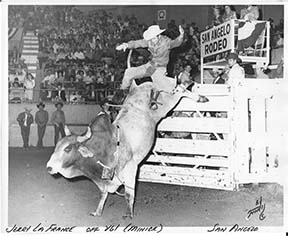
V61 was a bull that was known by the brand on his hip.  He was only ridden five times in all the time he was bucked, which is rare.  Sloan Williams, of Hungerford, Texas, was providing calves to Billy for his rodeo roping events.  Williams also provided all the stock for the Loretta Lynn Rodeos, that were primarily held in the eastern part of the United States, and were independent rodeos, not affiliated with the PRCA.  He asked Billy if he would be interested in buying V61.  Williams said, “No one will get on him anymore at our rodeos, he’s such a hard bucker.  I’m hauling him for nothing.  Would you like him”?  Billy had bought Harry Knight’s Rodeo Company in 1968 and was always interested in good bucking stock.  Billy and his dad took a gooseneck trailer to Williams place to pick up V61 and another bull inmAugust, 1969.   

PictureJerry LaFrance being ejected by V61 at the San Angelo rodeo. Photo Courtesy of Ferrell Butler.
Rudy Vela, well-known provider of good bulls in rodeo, raised V61.  The story that was told was that V61 was an orphaned calf and was ‘supposedly’ raised on a bottle.   He was out of a Brahma bull and a Jersey cow. A few years back when the Vela’s were being inducted in the Texas Rodeo Cowboy Hall of Fame Minick had an opportunity to talk with Mrs. Vela, who confirmed that they had, in fact, raised him on a bottle.

​Minick grew up loving rodeo.  He was the 1958 Texas High School Bull Riding Champion.  He joined the RCA in 1959 and qualified as one of the top fifteen bull riders for the National Finals Rodeo 1966.  Unfortunately he was injured in the last rodeo, the Cow Palace, before the National Finals Rodeo, so his ability at the Finals was affected greatly! He finished fourth in the world behind Freckles Brown, Bob Wegner and Ronnie Rossen.  Minick only won $105 at the National Finals, so his $14,358 for the year was primarily won before the Finals. 
 
The following year, 1968, he bought Harry Knight’s rodeo company and switched from being a competitor to a stock contractor.  Knight, who had been involved in rodeo since the 1920s could then retire.
 
V61, 1800 pounds of muscle with a jersey-coloring on his head turning into gray on the rest of his body, quickly gained a reputation for being a bull no one could ride.  He had bucked all the ‘old toughs’ off.  At one rodeo before the bull riding Myrtis Dightman told Minick he could ride V61.  Minick disagreed with him.  As he watched Dightman get ready in the chute Minick said, “I watched him pull his rope tight, then he let the rope off a little, then he pulled it tight again.  When the chute opened Dightman went off the bull in a very  few seconds.” 

​Life Magazine made a special trip to Cheyenne Frontier Days to do a story on V61 that can be found in the October 23, 1970, issue.  V61 went to the National Finals that year and was bucked three times.  In round one he bucked off Bobby Berger.  In round six, he injured Dicky Cox so badly he spent nine days in the hospital having surgeries on his head and face.  In the tenth round, he bucked Sandy Kirby off.  He was awarded Top Bull for the 1970 National Finals.

Picture
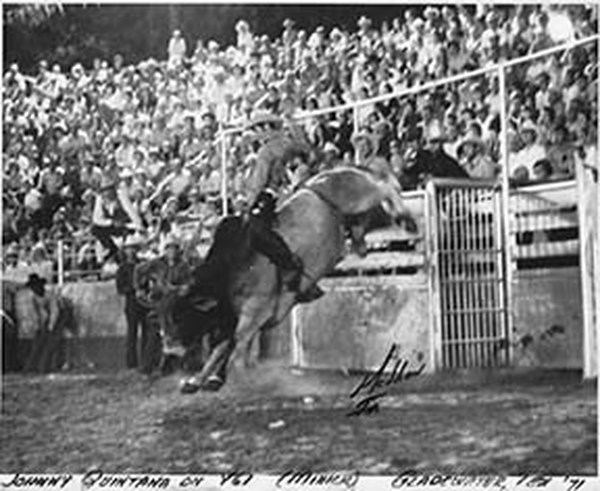
John Quintana and V61 making rodeo history in Gladewater, Texas, in 1971, with the highest marked bull ride in the history of professional rodeo with 94 points. Photo Courtesy of Bruce McShan.
On June 6th, 1971 at the Gladewater (TX) Round-Up Rodeo 23 year-old John Quintana, of Creswell, Oregon, drew the famous unridden V61.  Ironically, Dicky Cox was one of the judges at Gladewater.  He remembered his time attempting to ride V61 and wondered if Quintana would have the same fate that he did.  He certainly hoped not. Quintana, the two-time National Finals qualifier, carefully prepared his rope in the chute atop the black-horned bull.  The crowd waited eagerly for Chute #3 to swing open.  Once it did, they began cheering Quintana on so loudly that when eight seconds were up he didn’t hear the horn and continued to ride.  The judges scored him with a 94.  A score of 94 had never been given before in professional rodeo.  The crowd went wild!  Rodeo history was made!  Later Minick admitted he thought if Quintana ever drew V61 he might be the man who could stay on him for eight seconds. 
 
The Gladewater Round-Up Rodeo committee honors rodeo legends and in 1996 they gave Minick silver spurs in honor of V61.  In 2010 they presented Minick with the original white chute gate #3, with the statistics of the Quintana vs. V61 ride, 94 points, branded on it.  He displayed it at Billy Bob’s until recently, and now is on display in the Texas Bull Riding Hall of Fame located in Cowtown Coliseum.  However, each June the chute gate returns to Gladewater for display during their rodeo, then returned to Fort Worth to be enjoyed by the crowds of tourists that flock to the Stockyards area.
 
In San Angelo in early 1971, Freckles Brown, 1962 World Champion Bull rider, drew V61.  Freckles was 50-years-old.  Minick said he was concerned when he learned Freckles had drawn V61 because he bucked so hard.  “I remember saying a prayer before he rode. ‘God, please don’t let him hurt Freckles’,” said Minick.  V61 came out of the chutes like a milk cow, about six seconds into the ride he dropped his shoulder to the left and dumped Freckles.  Minick had traveled with Freckles back in 1966 and considered him a good friend.  Regardless of their rodeo competitiveness cowboys do look out for one another.
 
The nine-year-old gray bull suffered a hematoma of the spermatic vessel in August, 1971, and Minick sent him to Dr. W. A. Aanes, a well-known veterinarian at Colorado State University in Fort Collins.  The surgery was less hazardous than first anticipated, but V61 became quite a celebrity at the school.  Aanes was a good friend of Paul Harvey, the radio celebrity that was well known for his stories about interesting events happening around the United States.  During V61’s stay at the college Harvey gave a daily radio report on V61’s condition and recovery and finished each broadcast with his familiar statement “and that’s the rest of the story."
 
By September the bull was back home near Fort Worth where he convalesced, by doctors' orders, until the 1971 National Finals.  At the National Finals, held in Oklahoma City, V61 was ridden in the 1st Round by Bobby Berger, who rode him for 8 seconds and scored 79, which gave him the win for that round.  He was drawn in the 10th Round by Bill Nelson, who bucked off.
 
In Fort Smith in May of 1972 Andy Taylor drew V61.  The dirt was real deep in the arena and is tough on roughstock to really get a good buck.  When Taylor came out of the chute he rode V61 and took his hat off and fanned him.  Minick admitted it made him so mad, and told Taylor, “As good as that bull has been for this business, you didn’t have to do that!”  Minick felt that Taylor’s cavalier action diminished V61’s history as such a top-rated, un-ridable bull.
 
At the 1972 National Finals, V61 was drawn in the first round by John Dodd, who bucked off.  In the sixth round  Phil Lyne drew him and rode him for a score of 70.  Minick had decided after the National Finals he’d never buck him again.  However, Bob Watt, who ran the Fort Worth Stock Show Show & Rodeo, asked Minick to please buck him at Fort Worth one more time, and then retire him.  Minick agreed.  When the draw was made Andy Taylor had drawn V61.  Minick made sure V61 was warmed up and ready to buck.  Minick said, “I was on the chutes, and when V61 bucked Taylor off, I threw my hat out across the arena.”  Owners of these champion bulls and broncs root for their stock just like friends and families root for their cowboys.  It’s only natural.
 
When V61 was retired he had been ridden only five times.  John Quintana rode him twice.  Bobby Berger, Phil Lyne and Andy Taylor were the only other bull riders to successfully ride the handsome, hard bucking bull.  What an outstanding accomplishment for an animal that was bottle-fed as a calf.  Very few bulls or broncs have that kind of a record in the rodeo arena.  I was once told by a long-time stock contractor and rodeo producer, Reg Kesler, “The better they buck means the bigger their heart is.”  V61 must have had a heart as big as Texas!
 
When V61 died in 1974 Minick had his head mounted, and the brand, V61, on his left side saved and framed.  The regal-looking bull’s mount hung in Billy Bob’s Texas, the biggest Honky Tonk in the world, for the world to see this outstanding animal for some time.  Today he has been moved to the Minick ranch and mounted in a prominent place with all his awards and brand displayed below him.  As Minick said, “Every stock contractor wants to have one great one, and V61 was mine.”
4 Comments

Vote for Derek Clark, Outstanding Bronc Rider

6/14/2016

0 Comments

 
Derek Clark is on the ballot for the Rodeo Historical Society Rodeo Hall of Fame.  He is highly qualified for induction and I recommend him without recourse.  His grandfather, Charley Beals, and great-grandfather, Monroe Veach, have been inducted in the past.  His grandmother, Imogene Veach Beals was awarded the prestigious Tad Lucas Award, given to women who have given ‘above and beyond’ for the sport of rodeo.  He and his entire family has promoted and volunteered to keep the Rodeo Historical Society alive and well.  Rodeo Historical Society was initiated to honor those cowboys and cowgirls who truly gave their all in the rodeo arena and afterward. 
 
Oklahoma born and raised, Derek Clark, was surrounded by rodeo talk growing up.  It’s no wonder he chose to be a rodeo cowboy.  His dad, Duke Clark, was a roughstock rider, as was his grandfather, Charley Beals.  In fact, his great-grandfather, Monroe Veach, was a trick roper, put on rodeos, and learned to make saddles which were considered the best in his era. 
 
Derek was the oldest of three boys born to Duke and Donna Clark in Tulsa on September 3, 1960.  He was raised in eastern Oklahoma, near Colcord.  He competed in junior rodeos from the age of 12 in bareback riding, saddle bronc riding, bull riding as well as the roping events.  He competed at the High School level and won the saddle bronc title for the Oklahoma High School Rodeo Association in 1978, and qualified for the National High School Finals that  year held in Huron, South Dakota. 
 
When retiring in 2000, due to an injury, he had qualified for the National Finals Rodeo fifteen years in the saddle bronc riding event, from 1983 to 1999, only missing 1984 and 1997.  He was runner-up to the World Champion Saddle Bronc Rider in 1990 and had surpassed the $1,000,000 mark in winnings by year 2000.  Derek filled his PRCA permit in 1980 by riding in all three roughstock events.  He qualified for his first PRCA National Finals in the saddle bronc riding event in 1983 and won the third round.  He attended Texas Tech University at Lubbock and qualified for the College Finals in 1984, winning the National saddle bronc riding title and the average.   
 
Derek has won or placed in the saddle bronc event at most of the PRCA rodeos during his career.  Wins included National Western in Denver three times,  1983, 1989 & 1991; and Cheyenne Frontier Days in 1986.  His Circuit wins in the saddle bronc event include the Dodge National Finals 1991, plus the Prairie Circuit, Texas Circuit and Great Lakes Circuit in various years.  He also won many of the varied PRCA Series in the saddle bronc event.  Derek was also the 1993 Coors Fan Favorite Cowboy.
 
Derek always supported PRCA in various positions from Saddle Bronc Event Representative in 1998 and ’99, to PRCA Board of Directors from 1998-2005.  He was a member of the National Finals Committee Board from 1999 to 2005, Vice Chairman of Board of Directors from 1999 to 2004.  He was Board Chairman from January 2005 until August 2005, when he had to resign due to injury.  He also was on the Great Lakes Circuit Board of Directors in 1998 and ’99, and the Olympic Rodeo Committee, held at Salt Lake City, Utah in 2002.
 
After his competitive years he continued to work in the arena as a pick-up man at various rodeos until he sustained a serious injury at the Springdale Arkansas, rodeo in 2005.  As the pickup man his horse flipped over on him resulting in a serious leg injury that has required numerous medical procedures. 
 
Derek Clark has three children, Chase, Chelsea and Dally Kay, and continues to live at Colcord, OK.  Please consider voting for this outstanding saddle bronc rider, that gives back to rodeo in so many ways.  He truly fits the bill of a cowboy qualified to be inducted in to the Rodeo Historical Society Rodeo Hall of Fame.  Vote for Derek Clark!
0 Comments

The Texas​ Rodeo Cowboy Hall Of Fame Annual Induction Weekend

4/15/2016

0 Comments

 
April 8th & 9th saw quite a crowd of ‘real’ cowboys and cowgirls at the Stockyards in Fort Worth celebrating the 2016 Rodeo Reunion and Texas Rodeo Cowboy Hall of Fame Induction.  I’m not implying there are not ‘dyed in the wool’ cowboys in the Stockyards but any visit will prove the tourists from all over the world trek to Cowtown to see the “Old West."  It has become an impressive destination for those not lucky enough to live in the west.  Cowboys and cowgirls who have rodeoed and live on ranches are generally the minority.
 
Friday was a Golf  Tournament at the Oeste Golf Ranch in Weatherford.  Unfortunately one of the players, Ken Henry, fell out of a golf cart, hit the back of his head, and he had to have surgery to release the pressure from the brain.  Henry did not have insurance.  A fund raiser is going to be held April 24th starting at noon.  Mo Bandy will entertain, food will be available and donations will be accepted to help defray medical bills for Henry.  For more information call the Texas Rodeo Cowboy Hall of Fame at 817-624-7963.
 
A reception followed Friday at 5 p.m. and photo shoot in the Cowtown Coliseum where the plaques of former inductees are on display, and those being inducted this year were unveiled.  That evening 2016 inductees were introduced during the Stockyards Championship Rodeo.
 
Saturday morning at River Ranch, Cowboy Church started the day, with Ronnie Christian conducting.  The Opening Ceremony for Inductions began at 9:30 with Mike Hudson, President welcoming everyone and Presentation of the Flags.  Sheridan Hodge Elliot and Sierra Hodge, daughters of Tina Hodge, sang the National Anthem.  Invocation was given by Don Howell.  Once all past Inductees were recognized the program was turned over to Jeff Medders, Master of Ceremonies, with assistance from Rodeo Queens, Bailey Arrington, Miss Teen UPRA, Tianti Carter, Miss Rodeo Austin, and Sissy Winn, Miss Rodeo Texas Teen.
 
The first inductees were the Empty Saddles (deceased).
 Jack “J. B.” Bradshaw was a three event cowboy who started rodeoing in the mid-‘30s and won monies from Madison Square Garden to Calgary.  He coached the University of Texas’ first rodeo team, judged rodeos and was a member of the Cowboys’ Turtle Association.

Skipper Driver directed the PRCA Big Spring Cowboy Reunion for 30 years, was Howard College’s rodeo coach and took his team to the NIRA Finals four times.  He was a timed event competitor and while on the Texas Tech rodeo team qualified for the NIRA Finals twice.

Calvin Norris Greely,  Jr. was one of the first African-American cowboys to compete at the national level in the PRCA, and a leader in efforts to integrate the organization.  He was a strong role model for young black cowboys, excellent horse trainer and teacher of his trade sought by many rodeo notables.
 
The Trailblazers were next to be inducted with C. R. Boucher, who did not attend due to surgery.  He was a World Champion Steer Wrestler (1964) and National Finals Average Champ in 1961.  He was a pick-up man for Elra and the Beutler family for 26 years.  He was also a contestant director and Vice President of RCA and was inducted into the ProRodeo Hall of Fame in 2001.  His acceptance was represented by Dr. Fred Rule, veterinarian, from Elk City, Oklahoma, who said of C. R., “He kept a diary all his life, he didn’t like cheating, was tighter than Dick’s hatband, had a deep sense of humor, and a short fuse.  If there is a Number 1 cowboy for cowboys C. R. is one of them.”

John Stokes was a bull rider, bullfighter, team and steer roper and a stock contractor.  He helped form the first Tarleton College Rodeo Club and won the All-Around there.  He had over 250+ wins in bull riding, team roping, and has continued to be active in the rodeo world through putting on reunions and participating in Rodeo Clown Reunions, as well as President of the Rodeo Cowboy Alumni.  On accepting he said, “I have had the best partner in the world for 51 years (meaning his wife, Lynn).”

Lawrence Coffee broke the color barrier in professional rodeo.  He won virtually every open rodeo championship in Texas.  He also won the 1997 Senior ProRodeo Association World Championship in Ribbon Roping and Tie Down and the 1998 TSPRA Championship in those two events.  He said, “My mom told me I needed God in my life." I was young and told her, “No, mom, I just need my horse.”  He continued and said, “I guess I had faith in my horse, but she was right.  It also takes patience.”
 
The Western Heritage Inductee was the master of ceremonies for the day, Jeff Medders.  The well-deserving Medders has been a sportscaster for rodeo, and many other sports, with television coverage of the National Finals Rodeo and much more.  He also creates videos of various inductions, including the Rodeo Historical Society Hall of Fame in Oklahoma City, the Texas Rodeo Cowboy Hall of Fame and activities at the National Finals Rodeos.
 
Rodeo Personnel was the next to be inducted.  John Gass worked as a pick-up man for the 1974 and 1980 National Finals Rodeo.  His rodeo career wins included a NIRA saddle bronc championship in 1974, and four trips to the Texas Circuit Finals. Gass had a three year saddle bronc riding streak with no buck-offs.

“Goose” Gregg was a bull rider and stock handler from 1959 to 1997.  He rode bulls in open rodeos for 15 years.  He was chute boss for the weekly Boyd, Texas, Rodeo, North Texas High School Rodeo Association, Denton Youth Rodeo and Fair and more.  He also worked for the Texas Rodeo Circuit Finals and Copenhagen Skoal Superstars, and handled the stock for the bull riding at Billy Bob’s.
 
The Windy Ryon Memorial Roping was Event & Organization inductee.  Windy Ryon founded Ryon’s Saddle Shop and Western Store in the Fort Worth Stockyards, which was always a cowboy gathering place.  To honor Windy’s memory, his friends held the first Windy Ryon Memorial Roping in 1973.  Windy Ryon Arena has become a showcase for top level calf ropers, team ropers, steer ropers and steer wrestlers.  The Windy Ryon Memorial Roping Association has an annual world-class roping event which provides a scholarship program that honors the memory of an area cowboy or cowgirl who lived and loved the sport of rodeo.
 
Don Howell was given the Johnny Boren Award.  Don went to Sam Houston State University and rode bulls in central Texas.  He is Past President of the TRCHF.  He said his dad told him, “Your word is your bond.”  Don has lived by that advice.  He was president of the TRCHofF when it moved from Belton to the Stockyards and is very proud of that accomplishment.  He still works on behalf of the organization.
 
Animal Athlete inducted was “Pearl”, or “Big Smokin’ Wonder” owned by Texas Agriculture Commissioner Sid Miller, of Stephenville, TX, who accepted for the 18 year old sorrel mare.  She is a two-time PRCA-AQHA Tie-Down Horse of the Year with more than $1 million in earnings.  Ridden by Cody Ohl for several years.  Miller said, “God let me be the steward over that great horse.  Shane Hanchey was at Ellensburg and was $9,000 out from making the National Finals when he rode Pearl.  At NFR he split the first round and second round and made the finals in 13th place.  He won the average and gives Pearl credit for the win.”
 
The Director’s Choice was Ty Murray.  Larry Mahan was there to talk about Ty and when he first saw him as a Little Britches competitor.  Larry saw the talent in Ty and invited him to spend some time with Larry at his ranch in Colorado.  Larry said, “He destroyed my ego by winning seven world championships, to my six.”

When Ty came to the microphone he received a standing ovation.  Ty told the audience when he went to school in 1st grade he didn’t want to read, but he had a clever teacher that brought him a book about Larry Mahan, his idol, and because it was something he was interested in he learned to read.  Ty said when he accepted Larry’s invitation to his ranch in Colorado Larry flew his plane to pick Ty up in Phoenix where Ty lived with his parents.  Ty said, “I’d never been in a plane before, and as Larry and I flew he explained all the dials and equipment on the dash of the plane to me.  Then he picked up a pillow and said, ‘Ty, I’m going to take a short nap, you just keep this plane on course.’  I was 12 years old!”  After the audience’s laughter died down, Ty continued, “What I know now about Larry is he had one eye open watching to see how I would react.  I learned so much from him.  He taught me how important it was not to be afraid of an interview, and so much more.  It takes a lot of people to help you.  They told me I was good before I was good.  I ate, slept and drank bulls and horses and roping.  My sisters and my parents taught me so much, Tom & Betty O’Day were like second parents.  Delbert Salinas was up and down the road with me.  Jim Sharp influenced me greatly.  Cody Lambert was so instrumental in my success and told me to always expect to win first.  His wife was like a second mom.  I looked up to Ted Nuce and we’ve been great friends for 30 years.”
At this point Ted Nuce took over and said that he met Ty when he was 17.  Nuce told Ty, “Always have a good attitude.  Your attitude is going to determine your altitude.”
 
Woman Contestant inductee was Corley Cox accomplished at barrel racing, breakaway roping, team roping and goat tying.  She won the 2nd Annual Betty Gayle Cooper Roping All-Around Champion, a 4 time THSRA Barrel Racing Champion in 1978.  She has been to the NIRA finals 4 times when at Texas A & M, was a National Finals qualifier in 1992, and has qualified ten times for the Texas Circuit Finals and trained horses for 40 years.  She gave credit to R. E. and Martha Josey, Wanda Bush, Martha Wright and her hauling partner for 18 years Donna Kennedy. 
 
Men Contestants were the last group and first up was Russ Baize.  He was a bull rider, cutting horse rider and barrel horse trainer from Stamford.  He won many PRCA bull ridings.  He rode 67 bulls in a row at PRCA rodeos without a buck-off.  In the late 1970s he won over $100,000 riding bulls.  In 1976 he rode nine bulls in PRCA rodeos that had never been ridden before.

Art Ray competed in bull and bareback bronc riding in the 1970s and ‘80s.  He had trips to the National Finals in 1979 and 1980, and a Lone Star Bull Riding Circuit Championship in 1978.  He said Wacey Cathey taught him how to ‘go down the road’ and how to enter.   He said he and Wacey met a gal in a ‘speakeasy’ and she had a cast on her leg, in their fun making Wacey held the cast and Art poured his drink down the cast.  “Little did I know at that time she would become my wife!”

Lane Foltyn was a bull and bareback rider.  In 1977 he was Texas High School Rodeo Assoc. All-around Champion and in 1978 the Champion Bull Rider.  In ’79 he qualified for the NIRA bull riding finals.  He also had many other wins.  After retiring he mentored his sons and other young bull riders who went on to qualify for NFR and PBR.  He has been a PBR Finals judge for the past 15 years.

​Rusty Sewalt of DelRio won PRCA Coors Chute Out Champ in 1998; NIRA South Region Champion, five-time qualifier for National Finals, two time Dodge National Circuit Finals Qualifier.  He said his grandfather, Royce Sewalt, of King, Texas, won the Calf Roping World Title in the RCA 70 years ago, 1946.

Monty Penney rode bulls for 19 years.  He retired for ten years, then started again riding bulls with his son.  He judged rodeos nationwide, and was Bull Riding Director of the Texas Circuit from 1995 to 2000.  He said, “If I hadn’t gotten married Donnie Gay wouldn’t have won 8 championships!  I didn’t want to toot my own horn, but TOOT, TOOT, by God!”

And last but not least was Randy Vaughn, a steer wrestler, and two-time National Finals qualifier, 1978 and ’81, Texas Circuit Finals Steer Wrestling Champ in 1983, and much more.  He has had a variety of rodeo-related responsibilities such as Texas Circuit Finals Rodeo Official, Tuff Hedeman Championship Challenge Bull Riding Arena Director, PBR Finals Arena Director, Miss Rodeo Texas Pageant Judge, Windy Ryon Roping Committee member, and National Promotions Manager, U. S. Smokeless Tobacco Co., Copenhagen ProRodeo Program from 2000-2009.  He presently lives in Richmond, Virginia.  He said when he went back east to live he was often asked where he was from in Texas.  He said, “I always told them I’m from Chico, halfway between Sunset and Paradise.”  (When I came home I looked on the map to locate Chico and darned if he isn’t right!  It is exactly between Sunset, TX and Paradise, TX.)
 
Tina Hodge, Scholarship Chairman introduced the three young winners, who were Hanna Hemphill, of Huntsville, TX who will attend Texas A & M in Pharmacology; Clint Mayo, of Stephenville, TX who is attending Sam Houston State University majoring in Engineering; and Sissy Winn of Chapman Ranch, TX, who will attend Texas A & M majoring in agri-business.  All of these scholarship winners have competed in rodeo events, through FFA, High School Rodeo, etc.  They are all outstanding & deserving students.
 
The inductions ended about 2 PM, and everyone picked up their auctions items, and when we left the building God was giving us a wonderful rain to top off the day.
0 Comments
<<Previous
Forward>>

    Author

    Gail Hughbanks Woerner is one of rodeo's foremost historians, having written hundred of articles and six books on the subject. She has interviewed hundreds of cowboys and cowgirls,

    Archives

    May 2023
    May 2022
    December 2021
    November 2021
    June 2021
    May 2021
    April 2021
    March 2021
    December 2020
    November 2020
    August 2020
    June 2020
    May 2020
    March 2020
    November 2019
    July 2019
    June 2019
    May 2019
    March 2019
    January 2019
    November 2018
    September 2018
    April 2018
    March 2018
    February 2018
    December 2017
    November 2017
    September 2017
    June 2017
    April 2017
    March 2017
    February 2017
    January 2017
    November 2016
    October 2016
    August 2016
    July 2016
    June 2016
    April 2016
    March 2016
    February 2016
    December 2015
    October 2015
    September 2015
    June 2015
    April 2015
    March 2015
    February 2015
    January 2015
    December 2014
    November 2014
    October 2014
    September 2014

    Categories

    All

    RSS Feed

  • Home
  • Way Out West Blog
  • Books
    • Western Women Who Dared To Be Different
    • The Cowboy's Turtle Association
    • Rope to Win
    • Cowboy Up
    • Belly Full of Bedsprings
    • Fearless Funnymen
    • Willard, Colorado: A Special Place in Time
  • Contact
  • About
  • Schedule
  • Rodeo Clown Reunion
  • Links